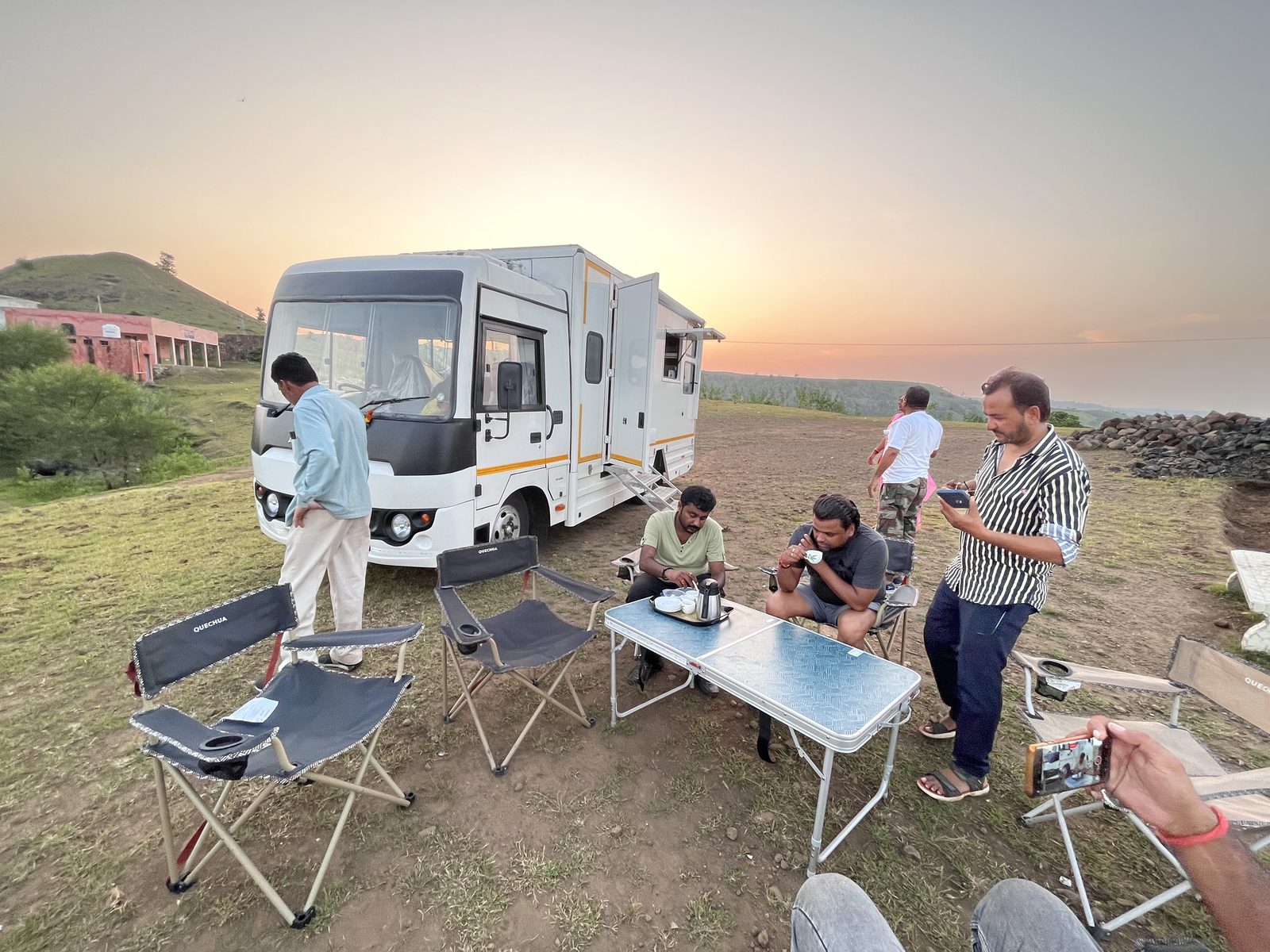
This is the trip that sells itself. Seven days, one caravan, and the slow unfolding of Rajasthan from Delhi’s sprawl to the emptiness of the Thar Desert.
We’ve run this route — Delhi to Jaipur to Jodhpur to Jaisalmer and back — more times than any other long-distance circuit. Whether you call it a caravan trip, an RV road trip, a motorhome holiday, or a campervan adventure, the route is the same: 2,000 km of India’s most dramatic landscape change, from green farmland to golden sand, with your accommodation, kitchen, bathroom, and crew travelling with you the entire way.
Here’s exactly how to do it, day by day.
Day 1: Delhi → Jaipur (280 km, 5-6 hours)
Morning pickup from your Delhi NCR home, hotel, or airport. The crew loads your bags, the helper starts chai, and you’re on NH48 before the city wakes up.
The Delhi-Jaipur highway is one of India’s best — six lanes, smooth, with the Expressway cutting the drive to under 5 hours. This is the gentle introduction: you settle into caravan life, figure out where everything is (the shower, the kitchen, the fridge full of cold drinks), and watch the landscape shift from urban sprawl to the Aravalli foothills.
Lunch: Cooked on board while driving, or stop at the famous Haldiram’s/Dawat complex near Neemrana. Most families do the first lunch on board — it’s when the kids realise this vehicle is different from anything they’ve been in.
Afternoon arrival in Jaipur. We park at the edge of the old city or at a quiet spot near the Nahargarh hills. The crew sets up the awning and outdoor chairs while you stretch your legs.
Evening: Walk through the Pink City at golden hour. Hawa Mahal, Jantar Mantar, the City Palace — all within walking distance of each other. Dinner at a rooftop restaurant in the old city (one of the few meals we recommend eating out — Jaipur street food is worth the experience), or cook on board if the family prefers.
Where you sleep: In the caravan, parked at a secure spot outside the old city walls. Air conditioning, your own bathroom, no hotel check-in. The noise of the city fades to nothing by 10 PM.
Day 2: Jaipur → Pushkar → Jodhpur (340 km, 7-8 hours)
This is the longest driving day, so we split it with a morning stop at Pushkar — 150 km from Jaipur, 2.5 hours on a scenic road through the Aravallis.
Morning: Amber Fort first thing (beat the tour buses by arriving at 8 AM). The caravan parks in the lower lot while you walk the ramparts. Back on board by 10:30, headed to Pushkar.
Pushkar (11 AM - 1 PM): The caravan parks near Pushkar Lake. Two hours to walk the ghats, see the Brahma Temple (one of the only ones in India), browse the bazaar, and eat at one of the lakeside cafes. Pushkar is compact — you see everything in an unhurried morning.
Lunch on the road. The helper prepares food while the driver covers the 200 km stretch to Jodhpur. This is where the landscape starts changing — the Aravalli greenery gives way to scrubland, the sky gets bigger, and the first hints of the Thar appear. The road is excellent (NH25, then NH62), straight and fast.
Jodhpur by evening. Park near Mehrangarh Fort with the blue city sprawling below. If you arrive before sunset, the view from the fort ramparts is one of the best in Rajasthan — the entire blue-painted old city glowing in the last light.
Dinner: On board, or at a rooftop restaurant near the clock tower. The crew handles camp setup while you explore.
Day 3: Jodhpur Day
A full day in the Blue City, with the caravan as your base.
Morning: Mehrangarh Fort — genuinely one of India’s greatest forts. Budget 2-3 hours. The audio guide is excellent. The caravan waits in the fort parking area; when you come down, cold water and lunch are ready.
Afternoon: Three options depending on your group:
-
Stepwell hunting. Toorji Ka Jhalra (a restored stepwell right in town) plus the quieter Mahila Bag Ka Jhalra. Both are walkable from the clock tower area.
-
Shopping. Jodhpur is famous for antiques, textiles, and spices. Station Road and the old city lanes around Nai Sarak have the best shops. The caravan’s storage means you don’t have to worry about how to carry purchases.
-
Bishnoi village visit. A half-day drive (40 km round trip) into the countryside to visit Bishnoi communities — India’s original conservationists. You’ll likely see blackbuck, chinkaras, and demoiselle cranes on the way. The caravan parks at the village edge; the crew makes chai for everyone.
Evening campfire. We move the caravan to a quiet spot outside Jodhpur for the night — a farm, a cleared area near the highway, or a pre-arranged camping spot. This is your first desert campfire: clear skies, no light pollution, the Milky Way visible to the naked eye.
Day 4: Jodhpur → Jaisalmer (285 km, 5-6 hours)
The most dramatic driving day. The landscape empties out: scrub gives way to sand, villages get smaller and further apart, and the horizon stretches to infinity.
Morning departure after a lazy breakfast. The drive to Jaisalmer is beautiful and uneventful — NH15 is a good road, mostly straight, with occasional camel carts and wind turbines for company.
Lunch stop at Barmer or Pokhran — both have decent dhabas and interesting sights. Pokhran Fort (where India’s nuclear tests were conducted) is a 30-minute detour. The caravan parks right outside.
Jaisalmer arrival, late afternoon. The first glimpse of Jaisalmer Fort rising from the desert flat is one of those moments you don’t forget. It appears like a sandcastle mirage — golden walls, medieval turrets, the whole thing seemingly carved from a single piece of sandstone.
Evening: Walk through the living fort — Jaisalmer Fort is one of the few forts in India where people still live inside the walls. Narrow lanes, havelis with incredible stone carvings, rooftop restaurants with views across the Thar. The caravan parks at a secure spot below the fort walls.
Day 5: Jaisalmer & Sam Sand Dunes
The day everyone remembers.
Morning: Explore what you missed last evening. Patwon Ki Haveli, Salim Singh Ki Haveli, and the Jain temples inside the fort — the stone carving here is as fine as anything in Italy. The old city is compact; you can walk everything in a morning.
Early afternoon: Drive to the Sam Sand Dunes (42 km west of Jaisalmer, about 1 hour). This is when caravan travel in India becomes something else entirely.
The Sam Sand Dunes camp. The Explorer parks on firm ground at the edge of the dune field. Our driver knows the exact spots — hard-packed sand that supports the vehicle, with dunes rolling away in every direction. The crew extends the awning, sets up the rooftop deck with cushions, and gets the campfire ready.
What happens next: You walk up the nearest dune. The sand is warm, the wind is quiet, and the only things on the horizon are more dunes. No tent camp. No generator humming. No shared bathroom block with 30 strangers. Just your caravan — with its flushing toilet, hot shower, AC, full kitchen, and real beds — sitting at the edge of the Thar like it belongs there.
Sunset on the dunes is the photograph. Camels silhouetted against an orange sky, the sand shifting from gold to pink to deep purple. We’ve seen it dozens of times and it still stops the crew in their tracks.
Dinner under the stars. The helper cooks dinner while you watch the Milky Way appear. No light pollution for a hundred kilometres. If you’ve only ever seen stars from a city, this will redefine what “night sky” means.
You sleep here. In the caravan, windows cracked, the desert absolutely silent. This is the night guests talk about for years.
Day 6: Sam Dunes → Jodhpur (285 km, 5-6 hours)
Sunrise on the dunes. Set an alarm — this one is worth losing 30 minutes of sleep. The dunes glow orange before the sun clears the horizon, and the shadows stretch for kilometres. Chai on the rooftop deck.
The return leg to Jodhpur retraces the highway. It’s the same road, but facing east the light is completely different — the desert seems to shine.
Stop at Kuldhara Ghost Village (20 km from Jaisalmer). An abandoned Paliwal Brahmin village from the 1800s — stone houses still standing, streets intact, nobody home. The caravan parks at the entrance; it’s a 30-minute walk through. Genuinely eerie and fascinating.
Lunch on the road, arrive Jodhpur by evening. We park at a different spot from Day 3 — maybe a farm on the Jodhpur outskirts with a view of the fort lit up at night. Second chance for any Jodhpur sights you missed.
Day 7: Jodhpur → Delhi (600 km, 10-11 hours)
The long drive home. We start early — 5:30 AM departure — and make good time on the highway.
Why one long day instead of two? Most families prefer to push through rather than spend a night at an anonymous highway stop. The caravan makes this bearable in a way no car can: the kids nap in real beds, the helper cooks breakfast and lunch on the move, there’s a bathroom whenever anyone needs it, and the driver rotates rest stops every 2-3 hours.
Route: Jodhpur → Ajmer bypass → Jaipur bypass → NH48 → Delhi. We skip the city centres and stick to the expressway.
Lunch: Cooked on board. The helper usually does something special for the last meal — a dessert, or everyone’s favourite dish from the trip.
Delhi arrival by 5-6 PM. Drop-off at your home, hotel, or airport. Unpack, and your Rajasthan circuit is done.
What It Costs
| Cost Component | Amount |
|---|---|
| Caravan rental (7 days × ₹19,900) | ₹1,39,300 |
| GST (18%) | ₹25,074 |
| Fuel (Delhi-Jaisalmer-Delhi, ~2,000 km) | ₹18,000-22,000 |
| Tolls | ₹3,000 |
| Food (cooking on board + dhabas, 4 people) | ₹10,000-14,000 |
| Total | ₹1,95,374 - ₹2,03,374 |
| Per person (family of 4) | ₹48,844 - ₹50,844 |
For context, 7 nights at comparable heritage hotels in Jaipur, Jodhpur, and Jaisalmer would run ₹7,500/room × 2 rooms × 7 nights = ₹1,05,000 for accommodation alone — before you add the Tempo Traveller (₹38,500), restaurant meals for 4 (₹42,000+), and the fact that no hotel will park you at the Sam Sand Dunes with a private cook and a hot shower. For the full cost comparison, see our caravan vs hotel breakdown.
The Kilometre Math
A 7-day booking gives you a pooled allowance of 2,100 km (300 km/day × 7). This circuit is roughly 2,000 km including the Sam Dunes detour and any side trips. That means you’ll stay comfortably within the allowance with room for a spontaneous stop at Kuldhara, a Bishnoi village, or a sunset viewpoint that catches your eye. If you do exceed the allowance, extra kilometres are charged at ₹50/km — transparent, no surprises.
What to Pack
The Explorer provides bedding, towels, kitchen equipment, and toiletries. For the desert circuit, add:
- Sun protection — hat, sunscreen, sunglasses. The Thar sun is intense even in winter.
- Layers for desert nights — temperatures can drop to 5-8°C in December/January. A warm jacket for the campfire and dune sunrise.
- Closed shoes + sandals — shoes for fort explorations and desert walks, sandals for the caravan and riverbanks.
- Cash (₹5,000-8,000) — village shops and smaller attractions don’t always accept UPI.
- Camera with a good low-light mode — the Sam Sand Dunes at sunset and the Milky Way at night are photographer’s dreams.
- Downloaded entertainment — phone signal is patchy between Jodhpur and Jaisalmer.
You don’t need to pack food. Our helper buys fresh ingredients at local markets along the route and handles the cooking — tell us dietary preferences when you book.
Best Season
October-March is the window. Within that:
- October-November: Warm days (28-32°C), mild nights. Post-monsoon greenery still visible in the Aravallis. Pushkar Camel Fair (November) if your dates align.
- December-January: Cool days (20-25°C), cold desert nights (5-10°C). Clearest skies for stargazing. Jaisalmer Desert Festival in February.
- February-March: Warming up but still comfortable. Holi celebrations add colour everywhere. Last window before the heat sets in.
Avoid April-September. The Thar exceeds 45°C in summer, and monsoon (July-September) makes the desert roads muddy and unpredictable.
How to Book
Message us on WhatsApp with your dates and group size. We’ll send you a day-by-day itinerary customised to your interests (more time at forts? More desert camping? A Bishnoi village visit?) and a transparent cost breakdown within 24 hours.
Book your Jaisalmer circuit on WhatsApp →
No inquiry forms. No booking engine. No middleman taking a commission.
Frequently Asked Questions
How many kilometres is Delhi to Jaisalmer by road?
The direct route is about 780 km via NH48 and NH15, roughly 12-14 hours non-stop. In a caravan we break it into two driving days with an overnight in Jaipur, which makes it comfortable and lets you see more along the way.
Is the road to Jaisalmer safe for a large vehicle like a caravan?
Yes. NH48 to Jaipur and NH15 onward to Jodhpur and Jaisalmer are well-maintained national highways. The Explorer is built on a 6-wheeled Ashok Leyland chassis with air suspension — the same platform used by commercial transport across India. Our professional driver has run this exact route repeatedly.
Can you actually camp at the Sam Sand Dunes?
Yes. The Explorer parks on firm ground at the edge of the dune field. Our driver knows the exact spots where the sand is hard-packed enough to support the vehicle. You sleep in the caravan with AC, a real toilet, and hot shower — not in a tent with a shared bathroom block.
What is the best season for a Delhi to Jaisalmer caravan trip?
October to March. Daytime temperatures are 20-28°C, desert nights are crisp and cool (perfect for campfires), and the Jaisalmer Desert Festival runs in February. Avoid April to June when the Thar exceeds 45°C.
How much does this 7-day trip cost?
The Explorer at ₹19,900/day for 7 days comes to roughly ₹1,95,374-₹2,03,374 all-in including GST, fuel, and tolls. For a family of 4, that works out to under ₹50,000 per person — comparable to heritage hotels once you factor in transport, meals, and the cook.
Is there enough water for 7 days in the desert?
The Explorer carries 500 litres of fresh water with an RO purifier. For a family of 4, this lasts 3-4 days. We refill at towns along the route — Jaipur, Jodhpur, and Jaisalmer all have municipal water points our driver knows. You’ll never run out.
Want this trip with different stops or more days? Send us your wish list on WhatsApp — we’ll build an itinerary around your interests.
Related reading:
Why The Explorer Is Different
India's only caravan with a fully working toilet & hot shower, 1000W solar panels for off-grid power, RO water purifier, twin ACs, 120L fridge with freezer, and a rooftop deck. Professional driver + helper included at ₹19,900/day.
Founder, My Rolling Homes · @TheLazyNomads
Aman has driven caravans across India since 2020 — from the deserts of Rajasthan to Ladakh's highest passes. He built The Explorer from scratch, obsessing over every detail so travelers could experience India's wildest roads without compromising on comfort.
Ready to Plan Your Trip?
Tell us your dates, route, and group size — we'll put together a personalized itinerary.
Chat on WhatsApp