Every year, thousands of Indian companies spend between INR 50,000 and INR 2,00,000 per head on corporate offsites. The format is almost always the same: a resort in Manali, Jim Corbett, or Goa. There is a conference room with a projector. There is a “team activity” that involves blindfolds or ropes. There is a buffet dinner where the CEO gives a speech. Everyone flies home on Sunday feeling tired but not particularly closer.
The problem is not the intention. Offsites genuinely matter for small teams — the kind where 6 to 12 people need to actually like working together. The problem is the format. A resort offsite is just your office transplanted to a nicer building. The hierarchy stays intact, the phones stay on, and the bonding is a scheduled activity between meals.
A caravan offsite breaks that pattern completely. Here is why — and how the logistics actually work.
The Resort Problem
Before we make the case for a motorhome offsite, it is worth understanding why the standard corporate retreat underdelivers.
The phones never go off. Resort Wi-Fi and strong cell signals mean your team is still on Slack, still checking email, still taking “quick calls.” The offsite becomes a remote work day with better views.
The hierarchy travels with you. In a resort, the manager gets the suite, the junior gets the standard room, and the dinner seating arranges itself by seniority. Nothing about the physical space forces anyone out of their usual role.
The bonding is artificial. Trust falls, paintball, “escape rooms” — these activities are designed to simulate collaboration. But simulated collaboration does not build trust. Shared experience does. And a 45-minute activity between conference sessions is not a shared experience.
The logistics are fragmented. Flights, airport transfers, hotel check-ins, restaurant reservations, activity bookings — someone on your team (usually the most junior person) spends weeks coordinating all of this. By the time the offsite starts, they are already exhausted.
None of this means resorts are bad. They are perfectly fine for conferences, client events, and large-group offsites where you need meeting rooms and AV equipment. But for a small team that needs genuine bonding? The format works against you.
What a Caravan Offsite Actually Looks Like
Picture this instead.
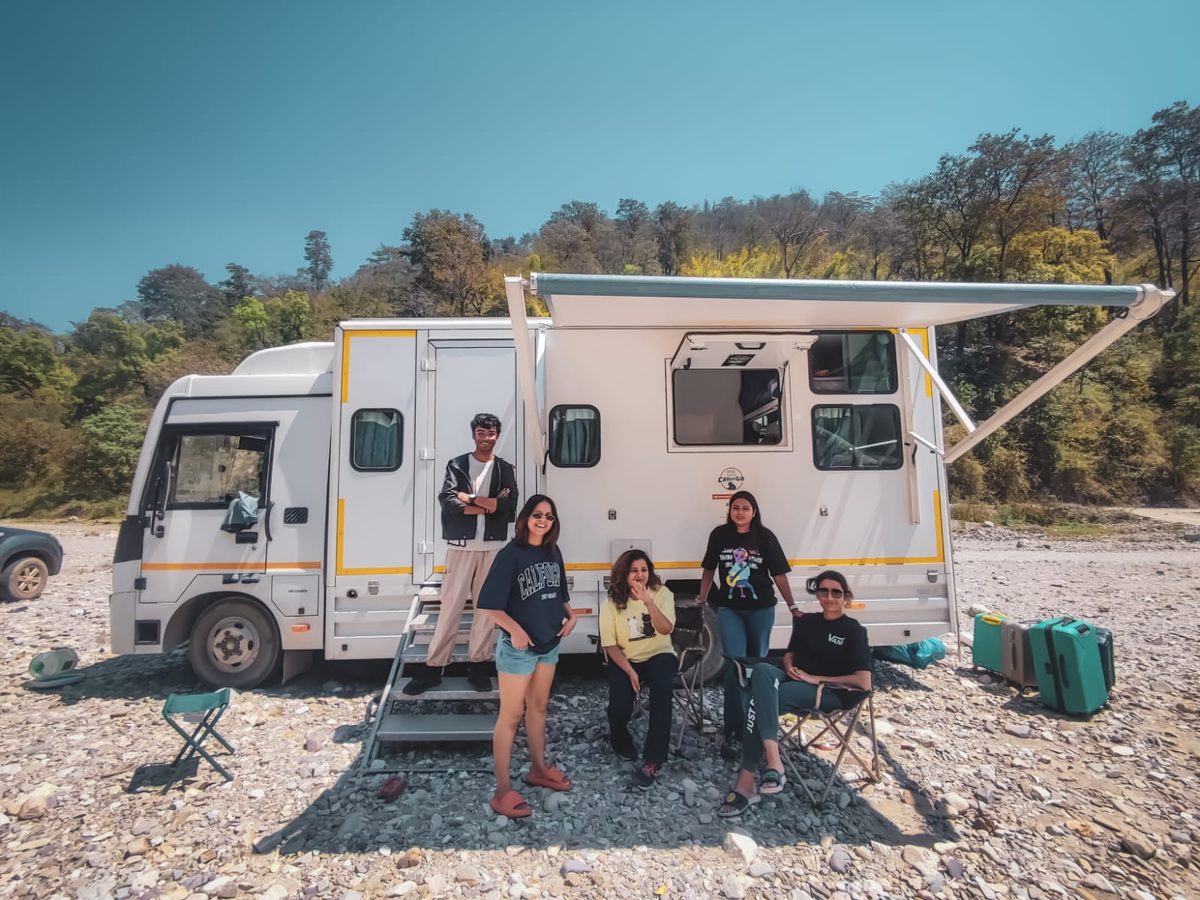
Your team of 4-6 people boards a fully equipped RV in Delhi NCR on a Friday morning. There is a driver — you are not navigating. The caravan has a kitchen, a bathroom with a hot shower, a dining area that doubles as a workspace, and sleeping berths. Your phones lose signal within two hours of leaving the city.
By Friday evening, you are parked at a riverside spot outside Rishikesh, or at the edge of the Thar Desert, or in a pine forest above Shimla. You cook dinner together — not because it is a “team activity,” but because the kitchen is right there and you are all hungry.
Saturday is the actual offsite. You hold your strategy session around the caravan dining table, with the Himalayas outside the window instead of a projector screen. You take a break by walking to the river, not by scrolling through Instagram. In the evening, you sit around a fire (not a conference room) and talk about the quarter ahead — or about nothing work-related at all.
Sunday morning, you drive back. Total logistics handled by your team: zero. Everything — vehicle, driver, fuel, parking, kitchen, accommodation — came in one booking.
That is the caravan offsite. It is not a gimmick. It is a format that forces the conditions under which real bonding happens: shared space, shared meals, shared novelty, and no escape hatch back to your inbox.
Why It Works: The Real Bonding Mechanics
Team bonding is not about activities. It is about three conditions that research on group cohesion consistently identifies:
1. Shared novel experience
People bond when they do something new together. A campervan road trip through Rajasthan is new for almost everyone on your team. The novelty — sleeping in a motorhome, cooking together, watching the desert go by — creates shared memories that a resort dinner simply cannot match.
2. Interdependence without hierarchy
In a caravan, everyone is in the same space. There is no suite for the VP and a standard room for the associate. You share a kitchen, you share a bathroom, you share the view. This physical equality quietly dismantles the office hierarchy in ways that a “flat structure” Slack channel never will.
3. Absence of digital escape
This one is underrated. On a resort offsite, your team is still connected. On a caravan driving through Spiti or rural Rajasthan, cell signal drops out for hours at a time. People actually talk to each other. They play cards. They stare out the window and think. The forced disconnection is uncomfortable for about two hours and then becomes the best part of the trip.
Cost Analysis: Caravan vs Resort
Here is a realistic comparison for a 3-day offsite for a team of 6.
Resort offsite (Jim Corbett or Rishikesh):
- Flights or cab from Delhi: INR 6,000-12,000 per person = INR 36,000-72,000
- Resort accommodation (2 nights, 3 rooms): INR 30,000-60,000
- Meals (resort restaurant, 3 days): INR 18,000-30,000
- Activity packages (rafting, bonfire, etc.): INR 12,000-18,000
- Conference room rental: INR 5,000-10,000
- Coordination time: 15-20 hours of someone on your team
- Total: INR 1,01,000-1,90,000
Caravan offsite, same duration:
- The Explorer for 3 days at INR 19,900/day + GST: ~INR 70,400
- Groceries and meals (cook onboard + eat out): INR 6,000-12,000
- Coordination time: one WhatsApp conversation
- Total: INR 76,400-82,400
The caravan offsite costs 40-55% less than a mid-range resort offsite for a team of 6. And that total includes accommodation, transport, and a vehicle with a kitchen — there is no separate line item for taxis, hotel rooms, or meeting space.
For current rates and availability, check our pricing page.
The Phone-Free Factor
This deserves its own section because it is the single biggest advantage of a caravan offsite — and it is the one that CTOs and founders mention most often.
In a resort, you can ask people to put their phones away. They will not. There is Wi-Fi, there is cell signal, and there is always an “urgent” message that needs a reply. The offsite becomes a half-present experience where bodies are in Corbett but minds are in the Slack workspace.
On a motorhome road trip, the infrastructure solves this for you. Once you leave the highway corridor, signal drops. There is no Wi-Fi on the caravan. Your team is offline — not because you enforced a rule, but because there is genuinely no signal. The discomfort lasts about two hours. After that, people relax in a way they have not in months.
This is not a side benefit. For knowledge workers who spend 8-10 hours a day on screens, genuine disconnection is the most valuable thing an offsite can offer. A caravan delivers it automatically.
Logistics: How It Actually Works
This is where most team leads hesitate. The caravan sounds great in theory, but who handles the details? The answer: we do. All of it.
Here is how a booking works:
- You message us on WhatsApp with your dates, team size, and preferred vibe (mountains, desert, riverside).
- We propose a route — a day-by-day plan with driving times, stops, and overnight locations.
- You confirm. One payment, one booking, one point of contact.
- On day one, the caravan arrives with a driver and a helper. Your team boards, and everything else is handled — driving, parking, water refills, waste management, route decisions.
There is no coordination matrix. No flight bookings. No hotel room allocation spreadsheet. No “who is arranging the airport cab” group chat. One vehicle, one booking, one conversation.
The team lead who would have spent 20 hours planning a resort offsite spends 20 minutes on WhatsApp instead.
Who This Works For (and Who It Does Not)
A caravan offsite works exceptionally well for:
- Small teams (4-6 people) who need genuine bonding, not a conference
- Startup founding teams planning their next quarter away from the office
- Remote teams meeting in person for the first time
- Creative teams who do their best thinking outside a meeting room
It does not work as well for:
- Large groups (15+) who need multiple breakout rooms and AV equipment
- Client-facing events where you need a formal venue
- Teams that need constant connectivity for on-call rotations or live ops
If your team is 4-6 people and your goal is real connection over real conversation, a motorhome offsite delivers more bonding per rupee than any resort in India.
How to Book
Every caravan offsite starts with a conversation, not a form. Message us on WhatsApp with your team size, preferred dates, and what you are hoping to get out of the trip. We will propose a route, a schedule, and an all-inclusive quote within 24 hours.
You can also explore The Explorer to see exactly what the caravan offers, or visit our corporate offsite page for packages designed specifically for teams.
One RV. One booking. A team that actually talks to each other. That is the offsite.
Why The Explorer Is Different
India's only caravan with a fully working toilet & hot shower, 1000W solar panels for off-grid power, RO water purifier, twin ACs, 120L fridge with freezer, and a rooftop deck. Professional driver + helper included at ₹19,900/day.
Writer, My Rolling Homes
Siddharth covers the caravan and RV industry in India — from vanity van misconceptions to international traveller guides. He writes to help you make informed decisions before you book.
Ready to Plan Your Trip?
Tell us your dates, route, and group size — we'll put together a personalized itinerary.
Chat on WhatsApp