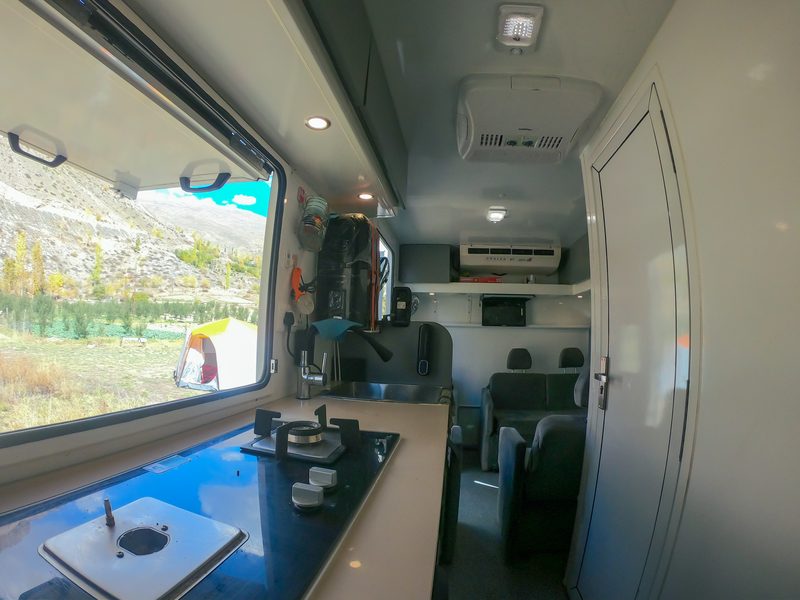
You searched for a caravan rental in India. There’s a 70% chance what you’ll get has no toilet.
That’s not an exaggeration. Most vehicles advertised as “caravans” on Indian rental sites are actually vanity vans — converted buses and trucks with plush seats and an AC, but no bathroom, no kitchen, and nowhere to sleep. You find this out at the pickup point, after you’ve paid, with your family standing beside their luggage.
This guide explains the difference between a caravan and a vanity van, why the confusion exists in India, and exactly what to ask before you book — so the vehicle that shows up matches the trip you planned.
What a Vanity Van Actually Is
The vanity van is a film-industry invention. Bollywood and Tollywood productions needed a private, air-conditioned space where a star could rest, change costumes, and take meetings between shots. So coach builders took a bus or truck chassis and fitted it out with premium recliners, mirrors and lighting, powerful AC, and often a TV.
For that job, a vanity van is genuinely excellent. It’s a rolling green room — comfortable, private, and impressive to pull up in. Film crews across Mumbai and Hyderabad rely on them every single day, and there’s a healthy market for a vanity van on rent for shoots, roadshows, and political campaigns. We’ve written before about how film productions use these vehicles.
But notice what the vanity van was designed for: day use, parked on a set, near a base camp with toilets and catering. It has no waste tank because the crew bathroom is fifty metres away. It has no kitchen because lunch comes from the production caterer. It has no real beds because everyone goes home (or to a hotel) at night.
None of that is a flaw. It’s just a different vehicle for a different job. The problem starts when someone lists that vehicle as a “caravan” and sells it to a family planning a five-day road trip.
What a Real Caravan or Motorhome Actually Is
Internationally, this category of vehicle has a clear definition. In the US it’s called an RV — a recreational vehicle. In the UK, Europe, and Australia, it’s a motorhome or campervan. The names vary; the standard doesn’t.
A real caravan is a self-contained home on wheels. That phrase — self-contained — is the whole test. The vehicle must let you live in it, not just ride in it. By international motorhome standards, that means four non-negotiable features:
- A working toilet with a waste tank. Not a portable bucket, not “we’ll stop at a dhaba.” A plumbed WC that empties into a sealed black water tank.
- A kitchen — a burner to cook on, a sink with running water, and a fridge.
- Proper beds. Fixed or convertible berths where adults can actually sleep for the night, not reclining seats.
- Self-contained water and power. Fresh water tanks sized for days of use, and onboard power (solar, inverter, generator) so the vehicle works away from hookups.
A vehicle missing any of these four is not a caravan, an RV, or a motorhome by international standards. It might be a very nice bus. It is not a home on wheels.
Vanity Van vs Real Caravan: Side by Side
Here’s what the typical Indian “caravan” rental actually delivers, compared with a genuine motorhome — using The Explorer as the reference point.
| Feature | Typical “Caravan” Rental in India | A Real Caravan / Motorhome (e.g., The Explorer) |
|---|---|---|
| Working toilet | ✗ | ✓ |
| Hot shower | ✗ | ✓ |
| Kitchen with burner | ✗ | ✓ |
| Fridge | ✗ | ✓ |
| Sleeping beds | ✗ | ✓ |
| Fresh water tank | ✗ | ✓ |
| Grey/black water tanks | ✗ | ✓ |
| Solar/off-grid power | ✗ | ✓ |
| RO drinking water | ✗ | ✓ |
| Overnight capability | ✗ | ✓ |
| Driver included | ✓ | ✓ |
The one row where the typical rental scores is the driver — and even that comes with a catch, because a driver on a vanity van still needs a hotel every night, which quietly adds to your cost and dictates your route.
Why the Confusion Exists in India
This mess isn’t really anyone’s evil plan. It’s the product of four overlapping gaps.
There’s no “RV” category in Indian vehicle regulations. The Motor Vehicles framework recognises buses, trucks, and campers in a loose sense, but there’s no distinct registration class for a motorhome the way the US or Europe defines one. A converted bus and a fully plumbed RV can sit under the same paperwork.
The film industry got there first. For decades, “vanity van” was the only word most Indians had for a large, luxurious converted vehicle. So when caravan tourism started growing, operators reached for the fleet they already had — vanity vans — and reached for the word that sounded more like travel: caravan.
“Caravan” sells better than “bus.” Tourism listings, Instagram reels, and rental aggregators all discovered that calling a vanity van a caravan gets more clicks. Since no regulatory body checks whether a “caravan rental” actually has caravan facilities, the label costs nothing and corrects itself never.
Foreign tourists get burned hardest. If you’ve rented a campervan in New Zealand or an RV in the US, the word “caravan” carries a firm promise: toilet, kitchen, beds, tanks. Visitors book an Indian “caravan” expecting that standard and discover the difference at pickup. We wrote a full caravan rental guide for foreigners visiting India precisely because of how often this happens.
The result: a genuine word with a hundred-year international history now means, in most Indian listings, “big vehicle with sofas.”
7 Questions to Ask Any Indian Caravan Rental Before Booking
You can cut through all of this with one phone call. Ask these seven questions, in order, and insist on specific answers — not “yes yes, all facilities available.”
- Does the vehicle have a working toilet with a sealed waste tank? Ask them to describe it. A real answer mentions a black water tank and how it gets emptied.
- Is there a shower with hot water? “You can freshen up” is not a shower. Ask about the geyser or heating system.
- Can I cook inside? A real kitchen means a burner, a sink with running water, and a fridge. If lunch requires stopping at restaurants, it’s not a caravan.
- Are there proper beds — can my family sleep in it overnight? Ask how many berths, and whether they’re beds or reclined seats.
- How much fresh water does it carry? Get a number in litres, and ask how many days that lasts between refills.
- Does it have off-grid power — solar, inverter, or genset — or do you need to plug in every night? India has almost no campgrounds with electrical hookups, so a vehicle that needs shore power will strand you.
- What happens to the grey water and black water? If the answer is a blank pause or “it drains out,” the wastewater is going onto the road — bad for you and worse for the places you’re visiting.
If the answer to questions 1–4 is “no,” you’re looking at a vanity van, not a caravan. That’s fine if you just need day transport on a film set. It’s not fine if you’re planning a multi-day road trip with your family.
Where The Explorer Fits
We built The Explorer because we kept asking those seven questions of Indian rental operators and kept getting silence. So we engineered a vehicle that answers “yes” to all seven.
- Water: 500 litres of fresh water on board — enough for days between refills — plus an RO purifier so drinking water comes from the tap, not from a crate of plastic bottles.
- Waste: a 150-litre grey water tank and a 100-litre black water tank, with proper sealed disposal. Nothing ends up on the roadside.
- Power: 1000W of rooftop solar, an inverter bank, and a backup genset. The Explorer never needs to “plug in for the night,” because in India there’s usually nowhere to plug in.
- Living: a working WC, a hot shower, and a kitchen with a 2-burner stove, sink, and fridge. Sleeps 4+2, so a family actually spends the night inside — parked by a lake, not checked into a highway hotel.
- Driving: chauffeur-driven, always. You watch the Himalayas; our driver watches the road.
As far as we know, The Explorer is India’s only rental caravan that meets international motorhome standards — the same checklist an RV in the US or a campervan in Australia would have to pass. You can see the full walkthrough on The Explorer page and current rates on our pricing page.
And if this would be your first trip in a motorhome, our guide to planning your first caravan trip in India covers routes, packing, and what the first night is actually like.
The Bottom Line
India’s caravan rental market is growing fast, but the vocabulary hasn’t caught up. “Caravan,” “vanity van,” “camper,” “luxury van” — listings use them interchangeably, and the vehicle behind the label can be anything from a genuine RV to a bus with recliners.
Until the vocabulary catches up, protect yourself: ask the 7 questions, get specific answers, and get them in writing before you pay.
And if you’d rather skip the homework — The Explorer is the answer. Message us on WhatsApp to check dates, or start with the pricing page. Your caravan will have a toilet. We promise.
Why The Explorer Is Different
India's only caravan with a fully working toilet & hot shower, 1000W solar panels for off-grid power, RO water purifier, twin ACs, 120L fridge with freezer, and a rooftop deck. Professional driver + helper included at ₹19,900/day.
Writer, My Rolling Homes
Siddharth covers the caravan and RV industry in India — from vanity van misconceptions to international traveller guides. He writes to help you make informed decisions before you book.
Ready to Plan Your Trip?
Tell us your dates, route, and group size — we'll put together a personalized itinerary.
Chat on WhatsApp